wine

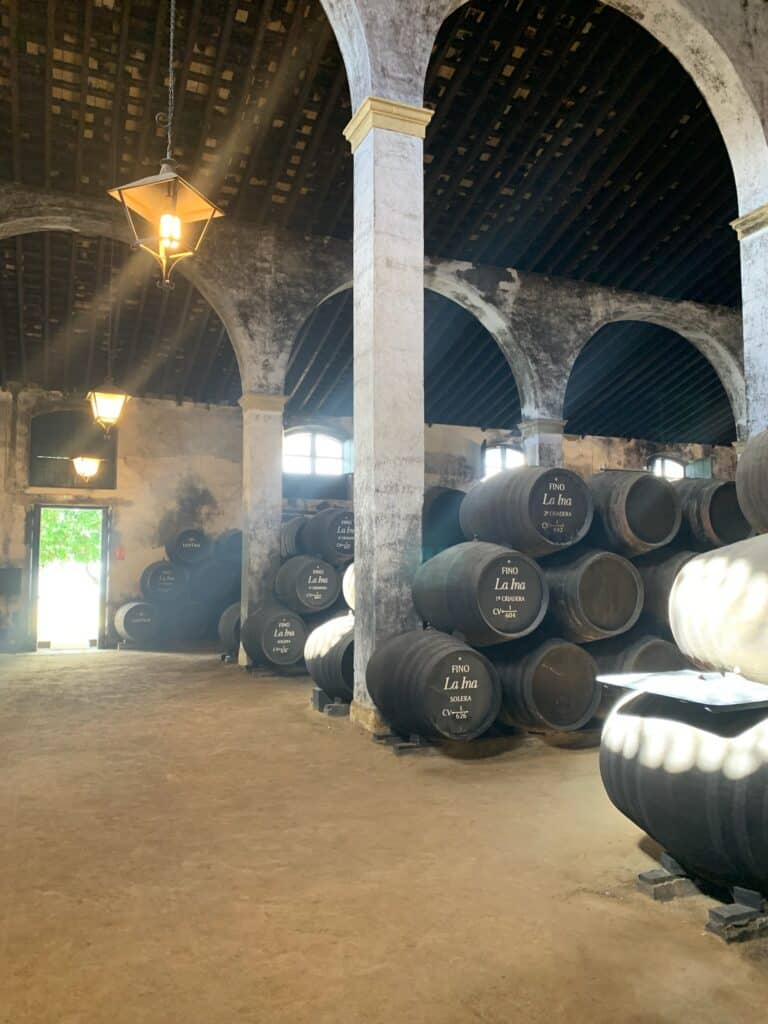
Inside a bodega.

Sherry – the heritage of Andalusia

Dear wine lovers, let’s discuss sherry. Have you heard about it before? What comes to your mind when you think about it? Rather sweet, technically a wine, but more like a liqueur? At least in Poland, from the perspective of an average wine drinker sherry remains quite an obscure drink. In most local wine stores and mainstream supermarkets, usually the only sherry on offer is an odd bottle of Pedro Ximenez. This creates a rather misleading picture of sherry wine. The distinctive and diverse sherry microcosm is lost. Not many wine regions can boast such unique wine making traditions and truly diverse types of wine; unlike any other in the wine world.

Sherry is made in southern Andalusia, Spain. Three towns north of Cadiz are known to create the so-called “sherry triangle”. I was very lucky this autumn to spend a few weeks in the region and managed to visit two of these sherry towns: Jerez de la Frontera (Jerez = sherry, in Spanish) and El Puerto de Santa Maria. They are not the typical pueblos blancos associated with the Andalusian countryside. They are rather big, urban areas with small historic city centres. What was unique were the large bodegas (wineries where sherry is made) which are immediately visible to any visitor entering the town. Even today, the bodegas are situated in prime city locations taking up sizable portions of the total square footage of the sherry triangle cities.

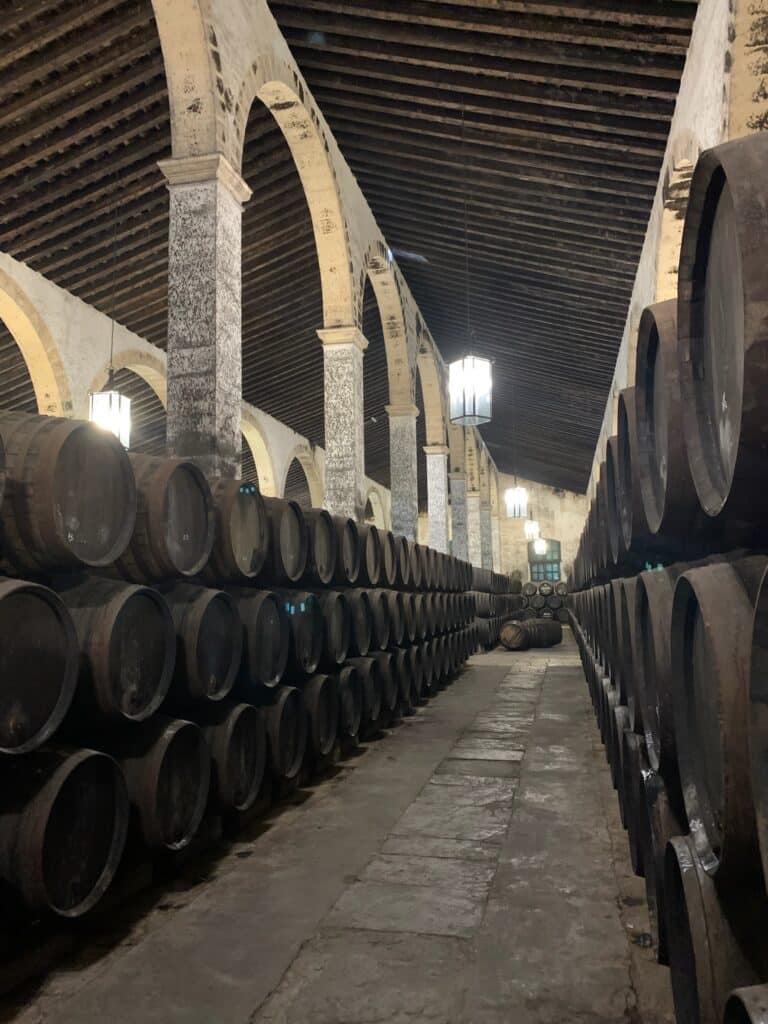
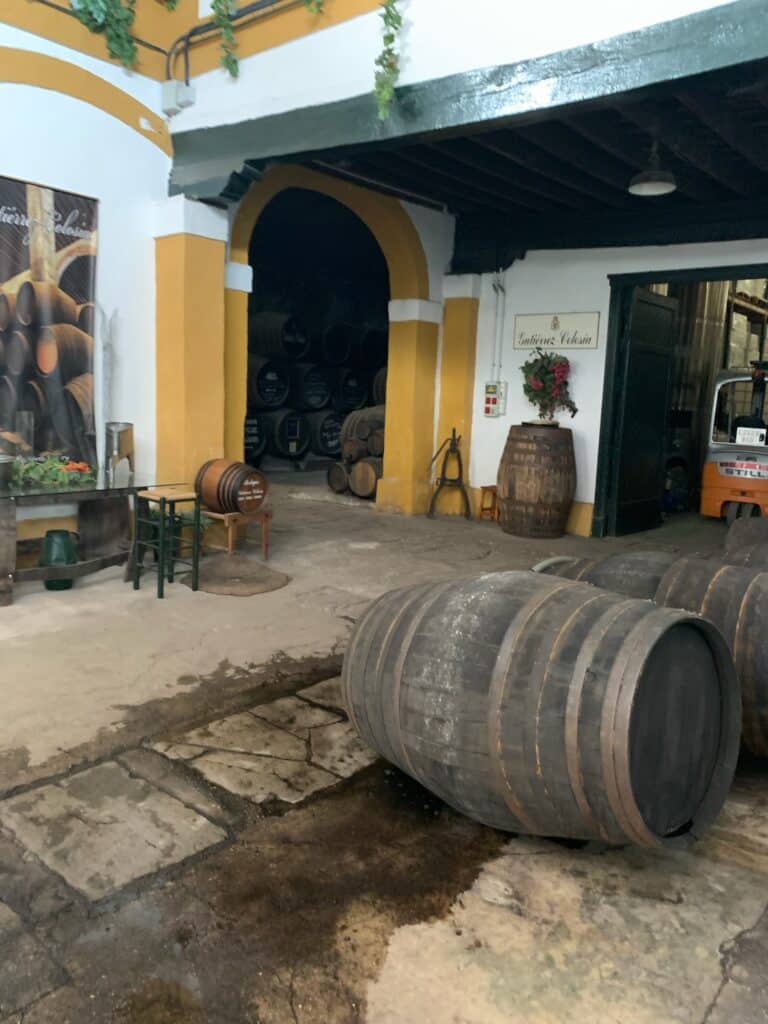
I visited two bodegas – Lustau in Jerez and Gutierrez-Colosía in El Puerto de Santa Maria. The former is a big, corporate operation while the latter, although of a decent size, is still a family business. In both places I opted for an extended guided tour and tasting. This way, I could fully admire the incredible interiors of the bodegas, often likened to cathedral churches thanks to their lofty architecture. This also allowed me to finally learn what sherry is really about! As I said before, sherry winemaking represents a very unusual approach, philosophy and history within the winemaking world and I learned quite a bit about it during my trip to Andalusia. That’s why I would like to share some of this sherry knowledge with you along with my take on it.
Sherry is made from two grape varieties – Palomino Fino and Pedro Ximenez. The first one is used to make dry wines, the second is used for dessert wines. All types of sherry from the Jerez region are fortified wines. It means that once the regular grape fermentation is done, the wine is supplemented with a distilled 40% grape spirit. Depending on the sherry kind, the final alcohol content is between 15-20%, while the sugar levels vary from tiny to mind-blowing 450g/l.

It was clear from my tour guides that the major part of the sherry making process takes place in the bodegas themselves. The grapes, fresh or already fermented, as well as the grape spirit are ordered by the bodegas from an external producer(s). Sherry makers practise their craft in the bodega, where common wine disappears and sherry comes to life. The art of making sherry lies in mixing of the vintages, ageing and resting the wine under very specific conditions. The origin and quality of the produce seems to be of secondary consideration. It’s not that it doesn’t matter, it’s just not really a part of the “official” sherry image and brand. This approach to winemaking is in stark contrast to the broader trends in the industry, where the importance of soil, climate, farming practices, etc. become more and more prominent. Many winemakers pride themselves in their minimal interference in the winery after the grapes are picked. They aim for the terroir (the complete natural environment in which a particular wine is produced) to speak through the grape. For example, this philosophy is ardently followed in Alsace (more details to follow in my next post).

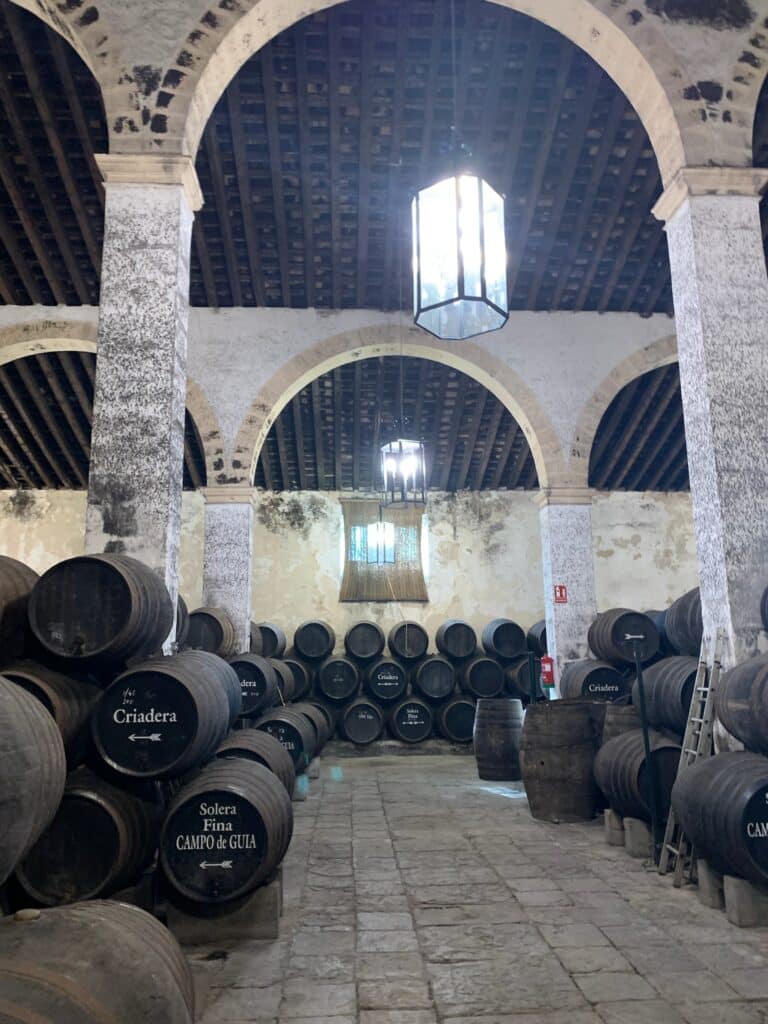
A special method, the solera system, is used to produce sherry wine. Simply put, the solera refers to stacked up rows of wine barrels, usually three. The top row carries the youngest wine, while the bottom one the oldest. Every year, in order to bottle new sherry, some of the liquid from the bottom barrel is removed, but never more than 30%. To fill the gap in the ground barrel, some of the wine from the middle row is transferred down. Similarly, the top row refills the middle row while brand new wine is added to the uppermost level. As a result, the final sherry in the bottle is always a blend of different vintages. This is exactly what a sherry maker aims for – consistent and predictable taste. Vintage fluctuations caused by changing weather conditions and the multitude of other factors are smoothed out by constant mixing.

Most bodegas make all sherry varieties. Fino, amontillado, oloroso and palo cortado are the dry sherries. Palo cortado is an elusive type of sherry with a really mysterious origin story. It’s a bit far-fetched for my taste, so I won’t go there for now. There is also manzanilla, a type of fino, that can only be produced in the third town of the triangle – Sanlúcar de Barrameda. The dessert sherries are cream and Pedro Ximenez (PX). Recently, some local producers also started to make vermouth.
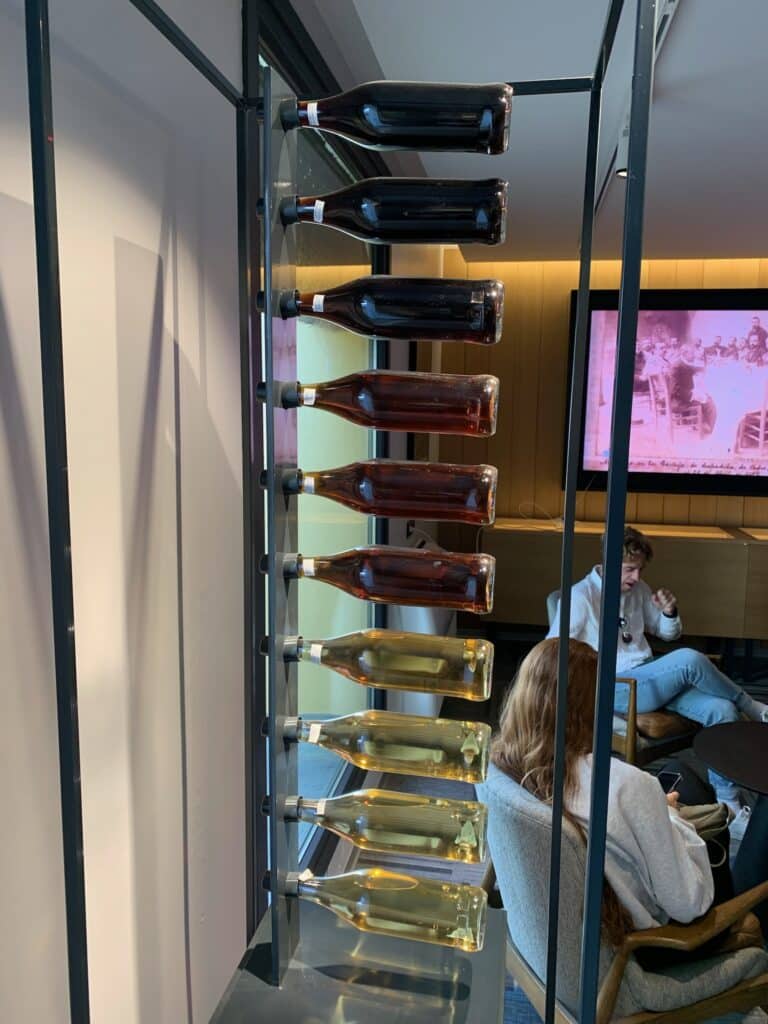
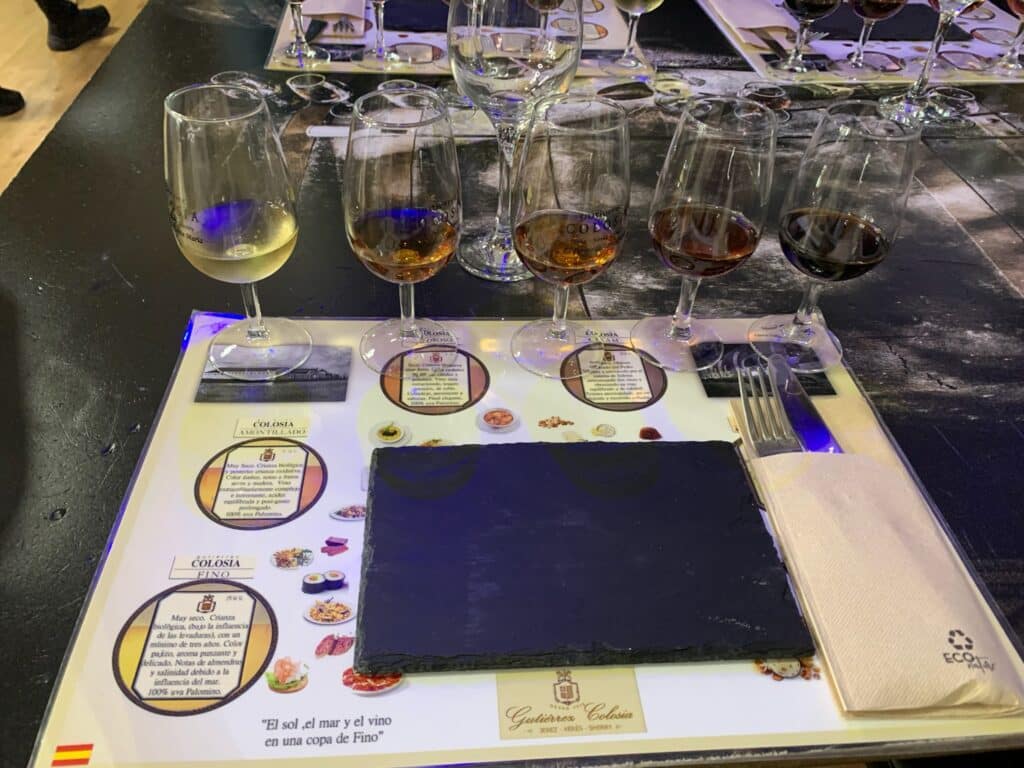
Fino is the youngest and freshest of the sherries. During the fermentation in the barrel, wild yeast forms a thick layer at the top called flor (flor, Spanish for flower). The yeast blooms like a flower. The flor blocks the oxygen from making contact with the wine. Hence fino doesn’t get oxidised and remains very pale, almost colourless. Wine makers leave the barrels only three quarters full to facilitate flor formation. Tasting in Lustau featured three different finos, each produced in a different town of the sherry triangle. Nevertheless, I enjoyed fino from Gutierrez-Colosía the most. It was the most elegant and understated, with prevailing citrus notes and sharp saltiness – very fresh, yet unique combination. Chamomile notes were also very pronounced. Now, a disclaimer: my very first encounter with fino was a shocking experience. I hadn’t tried anything like that before. It took me some time to get used to this style of wine and to actually be able to appreciate it.
Amontillado and oloroso are aged for much longer and in a different manner. For these styles, oxidation is crucial. Amontillado starts the same as fino, however at some point the flor is removed to let the oxygen in. Oloroso does not age under the yeast layer at all. Due to the oxidation and longer time in the barrel, these wines are much darker than fino. Dry wines from Gutierrez-Colosía reach the market when the youngest wine in the blend is at least 8 years old. I even tried a Lustau sherry in which the youngest “part” was 30 years old! This type of wine even receives its own regulation VORS which stands for very old rare sherry.

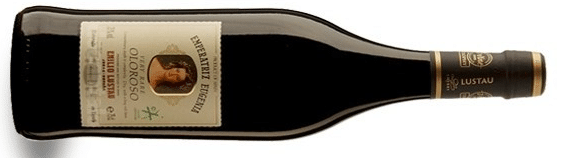
Sadly, amontillado and oloroso from Gutierrez-Colosía were not for me. They were quite acidic and lacked balance. The taste of pure alcohol was very strong as well. On the other hand, amontillado and oloroso Emperatriz Eugenia from Lustau are worth mentioning. Amontillado had a sweet aroma of caramel and nuts, but it was bone dry without a trace of sugar. Rather acidic and salty, it tasted of spices and mushrooms. Certainly, an acquired taste, but I was quite prepared this time after having tried a few finos. Oloroso Emperatriz Eugenia is 20 years old. Similarly sweet on the nose, there were clear orange, caramel and wet wood notes. Taste-wise, apart from lime and orange I also got a hint of dark chocolate. The wine was powerful, yet balanced nicely with a long finish. Beware, 20% alcohol content might pose a challenge for less seasoned drinkers.
Cream sherry is quite a sweet wine, but not always considered a dessert one. Cream from Gutierrez-Colosía is a 70%-30% mix of oloroso and PX. It gives notes of wet wood and tastes of raisins and dried fruit. Overall, this wine only hints on sweetness and is predominantly dry. I found it very intriguing.

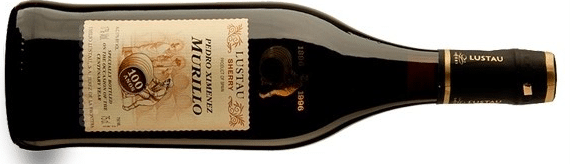
There is no other dessert wine like Pedro Ximenez. Sugar content can spike up to 450 g/l, so even a small glass can give you a kick thanks to its overwhelming honey-like sweetness. Dried fruit, caramel and chocolate dominate. For my cellar at home, I selected a PX from Lustau, which wasn’t included in the tasting. But their wines showed good structure and quality across the range.
Last but not least, I would like to highlight red vermouth from Lustau. When tried for the first time, Martini and other such drinks come to mind. However, Lustau’s vermouth is far ahead of the mainstream mass producers in terms of its flavour balance and precision. It was a pleasure to enjoy a combination of extremely refreshing orange and spices that reminded me of Christmas and ginger cake. Truly, 10 out of 10 in the aperitif department. It was a perfect way to get ready for dinner. Especially in Spain, where dinner is often not served until 9pm which is a bit of a challenge for me. A glass (or two 😉) of vermouth with just a slice of orange and a large cube of ice was a mandatory  start to a tapas-filled evening.

Discovering the world of sherry was a big adventure for me. Perhaps my greatest wine adventure so far. Maybe even too exciting and unexpected to unWined. I tried everything: from teeth-gritting finos to molasses-like, super sweet Pedro Ximenez. The range of sherry wines is absolutely amazing and unique. Vermouth too, took me by surprise! An amazing experience for sure, but I decided not to bring too many dry sherries home. A bottle of fino, more as a souvenir, not to quietly enjoy and reminisce about my time in Spain. I really get it now how niche the sherry world is, what it offers, why more and more bodegas are shutting down and/or limiting their production. Most sherries are simply a challenge for an average wine drinker, who’s not accustomed to its unique flavour profile. Sherry is doing fine locally, thanks to the strong tradition and because it goes well with local cuisine. Fino is particularly great for the abundant local seafood dishes. Outside of Andalusia, it might lose some of its charms. Even more so for casual drinking. As always, I recommend the sherry triangle to everyone, but the more adventurous wine lovers in particular. Those feeling less brave: please, consider yourself warned!
Sherry – the heritage of Andalusia Read More »

Black bear from free domain.

Virginia, USA – wine in the black bear country

If only I paid more attention to what I was reading. ‘’Virginia is the third largest wine producing state in the US. Most of its wine is only available directly in the local wineries. It’s a really unique opportunity to check out the wine from the region, because it’s hard to come by outside of the state.” – I was earnestly trying to convince my friends during our trip to Washington DC and New York. In my head, a perfect day trip plan to unWined had been hatched already. The second fact turned out to be correct, but although Virginia places in the top ten with regard to wine production in the USA, it’s still a far cry from leading California or Washington State. Luckily, either my doubtful wine facts or just a convenient excuse to escape a boiling city during a scorching day have done their magic and everybody was on board with the idea. We jumped in a mini SUV (the smallest option in a rental place full of Monster Truck-like cars) and shortly after we were on our way to explore Virginian ‘’spring’’.

Certainly, it would be a stretch to compare Virginia to the likes of Tuscany or Bordeaux, but in fact it has a long wine-growing tradition dating back to 1607. Four centuries ago settlers from Europe brought with them the first vine plants and the local viticulture started. One of the esteemed Founding Fathers, Virginia-born Thomas Jefferson, helped to kickstart wine production in the region. Unfortunately, up untill the 1980s the industry struggled, mainly due to extreme weather events and vine diseases. The situation improved since international vine varieties were introduced, accompanied by some modern growing techniques. The interest of some big names like Donald Trump, who has a winery there, helped to put the area on the wine map as well. 60% of the wine produced in Virginia is sold directly at the vineyard door. Although it’s technically “most” of the wine, for some reason my dubious research had led me to believe it was closer to 80%. Chardonnay, Vidal Blanc, Viognier, Cabernet Franc, Cabernet Sauvignon and Merlot are the most popular varieties grown here. This should be interesting!

The added bonus was a scenic route we decided to take through Shenandoah National Park and its Skyline Drive. We were really excited to have a chance to spot a black bear, one of the Park’s inhabitants, and of course enjoy the panoramic views of the nearby Blue Ridge Mountains. Our destination was Monticello AVA – one of seven appellations in Virginia (more info about the American appellation system here). Shockingly, bears were nowhere to be seen at this quite busy car route in the middle of the day. The views – nice, but nothing special to write home about. Despite that, we were having a great time driving slowly through the hills with Take me Home, Country Roads on the speakers. John Denver might be reminiscing about the neighbouring state of West Virginia in that song, but that day was definitely not about keeping to hard facts! After close to two hours we arrived at our first stop, Hark Vineyards.

This winery is a small family business, beautifully situated in the middle of the Virginian countryside. On our way there, we passed a lot of typical, big, plywood American houses on large plots of land. No fences anywhere. All very neat and lushy green – a picture of a lovely May day. The tasting venue was quite informal: outdoor tables and benches overlooking precise rows of vines, a small wine kiosk for the staff and mobile toilets. Definitely, a cosy, small scale operation. We felt very rustic indeed, when we saw bewildered faces of the staff who couldn’t believe we were visiting all the way from Poland. They immediately started to “discreetly” chat behind the counter: “But why would they come here”? – we overheard them asking incredulously. When we said we are from Warsaw, I hoped they knew we did not mean a town in Indiana…Cultural observations aside, it was time to try some wine! The tasting menu comprised 7 wines with a typical in the region skew to white wines. Little tasting jugs turned out to be not so little, so we could really indulge. Sadly, the wines we tasted weren’t very compelling, but at least we could enjoy gorgeous views and sunny weather as a consolation.

The majority of white wines: Sauvignon Blanc, Fuse or Virginia Verde (both made from Vidal Blanc) were rather simple-structured with mainly citrus notes. The oldest wine on offer, 2019 Petit Manseng, was standing out slightly because of its interesting exotic fruit aromas, in particular a pineapple. Still, it was quite a straightforward wine. The reds, composed of Bordeaux blends, tasted disappointingly flat. These wines, for sure, are a nice option for the locals to stock up on some decent everyday bottles. But we were more impressed with the views of the hills and the sheer alcohol uptake rather than the craftsmanship. We said goodbye to the still surprised farmers and headed to our next stop.

We arrived at Moss Vineyards soon after. Unlike the previous place situated in the mostly flat terrain, Moss Vineyards is tucked away in the midst of the nearby hills. This truly picturesque location is stunning, which made us linger for a bit with a glass in hand after the tasting was over. Moss offered 5 wines and an apple cider in its tasting package. Except for 2018 Architettura Riserva made from a Bordeaux blend, the wines were similar to the ones we tried in Hark winery. 2017 and 2018 Viognier were simply abhorrent, while Rose and 100% Cabernet Sauvignon were just ok. The way the tasting was run was quite bizarre as well. We were asked to stand in a line in front of the bar inside with our backs turned to the beautiful panorama, although there were no other guests and tables and terrace were free. The young gentleman who was taking care of us was equally shocked to hear where we are from. He was filing our glasses with really large portions, each wine in turn with no spit bucket. Then, he was looking at us in silence until we managed to finish each glass. “Maybe he is new in the business?” – I thought.

We got restless and a bit bored after a couple of glasses and tried to enliven the atmosphere with some chat about the area and interesting places to visit. So, we asked our host if the road we had seen driving there is this famous “Route 66”. Maybe we showed our ignorance, but in the end we were tourists and only starting our USA adventure. “Famous 66 – never heard of it, what’s that?”, was his answer. Luckily, the tasting was done, we grabbed a glass of riserva and made our escape to the terrace, smiling a little. And people say that Poland is a backwater! We were just glad that this trip had some extra fun, because so far the wine was pretty disappointing.

We finished the day in Early Mountain Vineyards, a big complex with a large restaurant, wine bar and a few tasting rooms. The winery can be booked for wedding receptions as well. The vibe reminded me more of a visitor centre in a famous tourist spot more than any other tasting venue we had visited. The place was packed, probably thanks to wider recognition – tasting in this vineyard has been selected as the best one in the entire country! Professional staff managed to find a table for us and explained our options. Because we had not booked in advance they could only offer us wine by the glass plus some nibbles. Shame we missed the famous tasting, but we were happy to have a chance to try anything. The restaurant ran like clockwork: in the 5 minutes we spent inside, we talked to three different staff members, each with a different role designed to make your experience as smooth as possible. Everybody had a big smile on their faces and they treated us in a typical American outgoing and open way. This time, we focused on red wines: 100% Cabernet Franc i 100% Cabernet Sauvignon – both made in 2019. On top of that, we had 2020 Foothills, a blend of five varieties typically associated with Bordeaux. Finally, our efforts to find something exciting paid off! Every subsequent wine, not unlike the winery itself, was precise and represented the character of the variety well. We savoured the notes of red fruit, cherries and raspberries, intertwined with chocolate, vanilla and cloves. We also ordered a plate of local cheeses to go with these proper wines. My friends and I agreed that our venture in Virginia was a fun adventure, but in terms of wine, Early Mountain decidedly saved the day. Now, I am not that sorry that Virginian wine is hard to get outside of the state.

Time for some reflections. In summary, in the “typical” American countryside we were met by borderline rudeness, ignorance and general indifference. Virginia can be proud of its long wine growing history, however the wine it offers today is rather mediocre compared to other American regions and globally. The best experience and wines came from a fully commercial operation. Politeness of the staff felt forced and was definitely trained rather than genuine. A 30% tip was suggested…. Usually, I try to avoid such a corporate approach opting in for a smaller and more genuine type of business where you often get a chance to meet the owner. Unfortunately (or maybe rather luckily this time), the formal business approach to winemaking won this time, both in terms of tasting experience and definitely in terms of the quality of wine. Virginian small, famer-run wineries still need to learn a lot from the industry gurus like Early Mountain to be able to proudly compete with the best. In my previous visits to countries such as Italy, Spain or France, I observed the opposite trend. Small scale operations often distinguish themselves with craft, high quality products on the level or even superior to big players. I wonder if this might be a US thing? It’s definitely difficult to say after just one visit. I have very little data to make this kind of statement. But somehow I could not shake off that feeling during the long journey back to our remote motherland in Central and Eastern Europe…

Virginia, USA – wine in the black bear country Read More »

View from Montepulciano.

Tuscany – more than a cliché? – part 1

For a wine lover Tuscany is a true classic, sometimes to a point of inadvertently becoming a cliché. Mesmerising views, mediaeval villages and hoards of American tourists – everybody knows that! So, if you are looking for a detailed description of the region, suggestions for day trips or history of Tuscany, I am afraid you will need to search elsewhere. What I will offer though is a brief account of my idea of a certain way to unWined during Italian holidays. Arguably, there is no better activity (or rather slightly tipsy inactivity) to partake in , than a group visit to some local wineries while in the sunny Tuscany. In my case, it was a fun family group of twelve. What could go wrong, right? At least, the bigger the group, the better a chance to find a designated driver!

Our first stop was Poliziano winery near Montepulciano. Definitely an elegant place with a wide, cypress-lined driveway, manicured lawns and classy wine tasting venue. Similarly inside: a big reception desk, glass cabinets full of wine bottles and well dressed staff. They were very accommodating and even though we had not booked, we were offered a tasting option. It was 20 euros per person for three wines. We were to sit at a big table with white tablecloth, next to other guests who were quietly sipping their wine. Suddenly, there were some quiet murmurs in our ranks, some morose faces and finally we decided not to go through with the tasting. Maybe, because it was just too early (not even 11 am), but I had a feeling that the group did not like the vibe of the place. Although quite lovely, the winery seemed a bit stiff and pompous – the exact stigma which makes wine inaccessible for so many people. It just did not fit our bill for a fun and informal day. A shame, but we were not disheartened. I just hoped that the next place on my list would be more to our taste! Back to the car then.

We didn’t have to drive for long and after barely 10 minutes we found ourselves in I Cipressi Winery. Just off a narrow gravel round, there it was – a simple and inconspicuous winery building. Outside, an older gentleman welcomed us with a big smile and inviting gestures. His dark complexion and calloused hands gave him away. It was not hard to guess that he was a hardworking farmer. Although the winemaker, Luigi Frangiosa, didn’t speak much English, our “Vino, taste, taste” was easy enough to comprehend. “My son, 2 minutes, wait”, he said – it must be a family affair we deduced. After a short while twenty-something, English fluent Manuel appeared. He excused his sore throat blaming it on the weather (in August, in Tuscany, really?). This could’ve been the cause, but we shortly learned that the previous day Montepulciano had had its annual Bravìo delle Botti festivities. During this holiday, teams from different neighbourhoods of the town compete in an unusual race. They race each other to the top of the steep hill while rolling wine barrels. The wine is not only rolled up but also consumed in large quantities. Anyway, our aunt offered Manuel a lozenge and we could focus on why we were all here.

The tasting featured a whole range of wines produced in the winery – we went from rose, Rosso di Montepulciano, Vino Nobile di Montepulciano to Riserva and Supertuscan (10 euro per person). Of course, we were most eager to try Vino Nobile. The name of this flagship wine from the area is associated with nobility that used to have a particular taste for it. The quality and rigorous rules governing the production of Vino Nobile di Montepulciano are safeguarded by its DOCG appellation status. Everybody seemed to be quite excited and relaxed in this more rustic set up. We couldn’t wait to start our Vino Nobile adventure. Manuel was leading the way, but Luigi kept watch by the door the whole time, casting quick glances full of pride at his son.

First, we were offered an experimental 2021 Rosato (a rose wine) made wholly from the most important Tuscan grape, Sangiovese. Manuel explained that it was just a second vintage of this less typical (for Tuscany) wine. I don’t have this on record, but I can’t help but think that this was Manuel’s idea. His contribution to modernise and refresh the traditional family winery. Our party was pleasantly surprised with the rose. It was fresh and enjoyable. Everybody instantly thought about drinking it by the pool in our Airbnb. We detected notes of ripe peach. Quite acidic taste made it really refreshing.

Next, we moved to the three local stars. First came 2020 Rosso di Montepulciano, 95% Sangiovese, 5% two other local varieties. It was nice and simple – aged exclusively in stainless steel tanks to retain freshness and approachability. Notes of red fruit, cherry and cranberry, dominated. A sip revealed a good balance with smooth and lively tannins. Certainly a great starter wine to get a feel of what the region and Sangiovese is about.

It was time for 2018 Vino Nobile di Montepulciano – 100% Sangiovese. This wine was aged for 2 years in slavonian (region in Croatia) barrels. Quite complex on the nose, with hints of leather, tobacco and blackberries. It was quite fresh, tasting strongly of plums and ripe cherries, with a hint of chocolate. Fairly tannic and acidic, it will surely improve in a few years. Satisfying finish lingered for quite a while.

Finally, the bottle of the most anticipated 2018 Vino Nobile di Montepulciano Riserva appeared. As in the case of the previous wine, it was 100% Sangiovese, but this time aged for longer. More complex ageing starts with 3 years in slavonian oak barrels, followed by 6 months of aging in bottle. The nose was full of tobacco, black pepper and spices. The wine was multilayered, mouth-filling with a very long finish. Flavours of prunes, tobacco and even coffee were detectable. My sister-in-law, who just recently started her wine journey, suddenly had a huge grin on her face. For the first time she tried a wine of this calibre, but she had no difficulty appreciating how well-built it was. Especially, when compared to some easier and fresher wines that we had tried in the past. We kept complimenting the wine in Polish, but Luigi seemed to understand us perfectly well and knew which wine we liked the most. He glanced at his son with that unmistakable: “I told you so” look. Have we been witnessing a quiet generation clash? The youth championing unconventional methods and experimenting versus the wisdom and traditional ways of the previous generation?

The younger winemaker peppered the tasting with tidbits of their family history. We learned that the Frangiosa family moved here from the South in the sixties, acquired some land and started to grow grapes for sale to other wineries. Later they decided to start making their own wine and market it under their own brand. Every now and then, Manuel was asking us some questions: how had we found them, where were we staying, etc. This showed that besides being a wine producer, he had a keen, business-oriented mindset that grasped how important it is to know your customers’ behaviour and create a certain experience for them. It was important for him to make his guests happy to make sure they would leave the tasting with positive reviews, write something online and tell their friends about the amazing time they had.

To finish things off we tried a Supertuscan, 2020 IGT Toscana, a blend of Sangiovese, Cabernet Sauvignon and Merlot. It was not too bad, pretty fresh and fruity. Regardless, I must confess I am not the biggest fan of Supertuscans. Why use international grape varieties in Italy, a country that boasts hundreds of indigenous ones?!

After we packed the cars with cases of wine we wanted to take home, everybody gathered on a terrace to soak up the view for a few more minutes: I Cipressi grape vines, rolling hills and dramatic clouds. My thoughts were coming back to the contrast between the two wineries we had visited that day. In the present experience economy, it’s a challenge to find the balance to be professional and authentic at the same time. The businesses opting for a high end and sophisticated look might suffer from being superficial and lacking substance (often being overpriced at the same time). On the other hand, if a business owner forgets that their customers are expecting a certain experience, that the winemaker is not just selling a product, but a story and a certain feeling, visitors might feel neglected and will not come back again! I Cipressi seemed to strike a really good balance.

It was only early afternoon so I finished my musings and looked ahead to the next stop of our classic Italian holidays. Andiamo!

Tuscany – more than a cliché? – part 1 Read More »

Dwór Kombornia.

Carpathian Wine Bar

We’ll make our start in a place that’s probably totally alien to many people and definitely not associated with wine, i.e. a Sub-Carpathian region in Poland! One summer day, we found ourselves in a city called Krosno in Lower Beskid in Southern Poland. From Krosno, we made our way to a nearby village of Kombornia with an 18th century manor house at its centre. The surrounding area can actually boast quite a few of those, which isn’t always the case in this strange country wrecked by two world wars and 50 years of communism. There was a certain serenity in this idyllic countryside setting. Although the house had been renovated and the exterior presented itself quite well, inside the effects of refurbishment were slowly fading away. It felt dated and not necessarily in a nice way. However, Kombornia Manor has one little gem hidden away inside a small hill on the estate’s grounds. This is where we found the Carpathian Wine Bar (or Salon, own translation; original Salon Win Karpackich).

The Salon is actually a large cellar. We immediately felt the temperature drop as we entered. Interior was definitely cooler and more humid than outside. Upon entry, we were welcomed by rows of wine bottles, which can be purchased later if anything catches the visitor’s eye. At the end of the corridor, we spotted a huge map illustrating the concept behind this Salon. Carpathian mountains were snaking through 8 countries in Eastern and Central Europe. We didn’t have the time to linger as Ryszard Skotniczny saw us to our places around the corner where the usual tasting set up of wine glasses and spitters was waiting for us. Ryszard created the Salon and incidentally also owns the whole place! He quickly gauged the collective wine experience and knowledge of the group and took us on a crazy wine journey through the Carpathian region.

We flew through Slovakia, Moldova, Romania and Hungary. We sometimes made a quick jump back to our home country, Poland. “Fly” seems like an appropriate term since we tasted 14 wines in less than an hour! The variety of wines was mind-blowing. We tried quite revolting attempts at a proper red wine from nearby wineries, way too sweet Romanian juice-like concoctions, but also delightfully complex aged white wines from Slovakia. We experienced some classics from Eger with rounded tannins and earthy notes that showed a great promise. “It’s not my goal for you to like every wine you taste today” Ryszard cheerfully explained. “After all, you all have different preferences and tastes, which makes it an impossible job. However, what I can do instead is to demonstrate the variety of what you can find in this wonderful region”. I really start to appreciate this approach given that quality is a relative concept, and it definitely helps to try wines made more skilfully and those which were given less attention by the winemaker. This is how we build up our mental library of flavours and likes, that ultimately helps us find and refine what we enjoy most. It’s also quite a refreshing and honest approach. Whenever I visit a winemaker directly, they will never admit that they have given a mediocre flavour to some of their wines on purpose in order to squeeze out as much as they can from their harvest and offer the wine at a budget price.

After the tasting, our sommelier and host was very generous with his time. We lingered on and chatted about decent local wineries and exchanged ideas for future wine trips to Hungary. Although we liked quite a few wines, we left the Salon with just two bottles. After a recent trip to Tuscany (watch this space for more details!) storage at home remains a bit of a challenge so I needed to be reasonable this time around.

The first bottle is a white wine, a 2016 Quercus Lipovina by Chateau Grand Bari from Slovakian Tokaji. Slovakian Tokaji? You might be wondering if I accidentally mixed up some countries. Definitely not! We learn that while Tokaji is a historical region that’s mostly associated with Hungary, its northern edge is actually part of today’s Slovakia. The wine itself is delightful and has aged very gracefully. It has a rich nose dominated by a lime tree honey with a hint of petrol. The wine is definitely full-bodied, well-balanced and complex. I detect honey, a bit of citrus fruits and even some pineapple. The finish is long and satisfying. It’s available for just 55 zł (c. £10).

The second one is a red wine, a 2016 Varvedo Cuvee by Toth Ferenc from Eger, Hungary. During the tasting we tried a Kekfrankos from the same winemaker but unfortunately that one was out of stock so I took a risk and went for Varvedo Cuvee. The bet definitely payd off! This classic Bordeaux blend (Cabernet Sauvignon, Cabernet Franc and Merlot) is a very pleasant medium bodied wine. I smell strong earthy notes supplemented by red fruits. On the palate chocolate and oaky notes dominate, but I can also taste some plums and blackberries. It definitely benefits from decanting it for 30 minutes or so. This one comes at 100 zł (c. £18).

The Salon is definitely a very interesting place and a thought-provoking idea. Rather than focus on a single country, the idea is to present the variety of wines and winemakers united by a mountain range spanning numerous countries. Although they produce different wines and are separated by national borders, in a way, they probably have more in common with each other than some winemakers from France or Italy or even winemakers from their home countries which do not feel the influence of the mountains. The Salon allows its guests to explore quite niche wines. Many of them are quite basic but every now and then we can find a real treat at a very reasonable price. We explored a true variety of wines, but for me it worked quite well because of the uniting concept behind the selection. What a contrast to some introductory tastings where we are asked to try a white from New Zealand, then a red from Chile and go back to the old good Bordeaux again. We might taste some wines but we learn very little. We also enjoyed the format of the tasting – it was a snappy, sensory experience with limited theoretical lectures. I believe anybody could enjoy it regardless of their “wine experience”. I definitely recommend it to anybody who finds themselves in this region!

Let’s also mention that the area, especially the city of Krosno, is famous for glass making. The local museum is a great way to learn more about the history of this craft and industry, but also purchase some unique hand-made goods. I also recommend an outlet shop from Krosno company (confusingly named exactly the same as the city!), where high quality wine glasses, decanters, and other glass items can be purchased at very reasonable prices. The boot of my car was definitely full of wine glasses as we all know there’s never enough of them. I wonder, what will fill them in the future? Cheers!

Carpathian Wine Bar Read More »

×